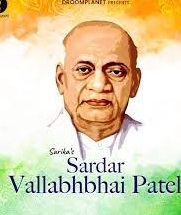
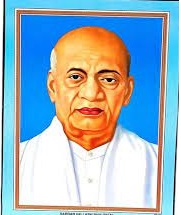
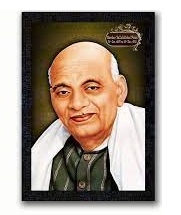
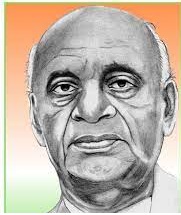
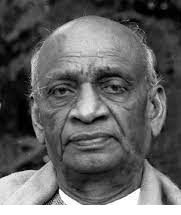
Sadar Vallabhabhai Patel
| Born |
31 October 1875 Nadiad, Bombay Presidency, British India |
| Died |
15 December 1950 (aged 75) Bombay, Bombay State, India |
| Political party |
Indian National Congress |
| Award | Bharat Ratna (1991) |
Vallabhbhai Jhaverbhai Patel (Gujarati:31 October 1875 – 15 December 1950), commonly known as Sardar, was an Indian lawyer, influential political leader, barrister and statesman who served as the first Deputy Prime Minister of India and first Home Minister of India from 1947 to 1950. He is also called the "Unifier of India". The Statue of Unity, the world's tallest statue which was erected by the Indian government at a cost of USD420 million, was dedicated to him on 31 October 2018 and is approximately 182 metres (597 ft) in height. He was a barrister and a senior leader of the Indian National Congress, who played a leading role in the country's struggle for independence, guiding its integration into a united, independent nation. He was one of the conservative members of the Indian National Congress. In India and elsewhere, he was often called Sardar, meaning "chief" in Hindi, Urdu, Bengali and Persian. He acted as the Home Minister during the political integration of India and the Indo-Pakistani War of 1947. Patel was born in Nadiad, Kheda district, and raised in the countryside of the state of Gujarat. He was a successful lawyer. One of Mahatma Gandhi's earliest political lieutenants, he organised peasants from Kheda, Borsad, and Bardoli in Gujarat in non-violent civil disobedience against the British Raj, becoming one of the most influential leaders in Gujarat. He was appointed as the 49th President of Indian National Congress, organising the party for elections in 1934 and 1937 while promoting the Quit India Movement. As the first Home Minister and Deputy Prime Minister of India, Patel organised relief efforts for partition refugees fleeing to Punjab and Delhi from Pakistan and worked to restore peace. He led the task of forging a united India, successfully integrating into the newly independent nation those British colonial provinces that formed the Dominion of India. Besides those provinces that had been under direct British rule, approximately 565 self-governing princely states had been released from British suzerainty by the Indian Independence Act of 1947. Patel persuaded almost every princely state to accede to India. His commitment to national integration in the newly independent country was total and uncompromising, earning him the sobriquet "Iron Man of India". He is also remembered as the "patron saint of India's civil servants" for having established the modern All India Services systemVallabhbhai Jhaverbhai Patel, one of the six children of Jhaverbhai Patel and Ladba, was born in Nadiad, Gujarat. He followed Vaishnavism and belonged to pushtimarg of Mahaprabhu Vallabhacharya and took the diksha from the descendant of Vallabhacharya. Patel's date of birth was never officially recorded; Patel entered it as 31 October on his matriculation examination papers. He belonged to the Leva Patel community of Central Gujarat, although after his fame, both Leva Patel and Kadava Patidar have claimed him as one of their own. Patel travelled to attend schools in Nadiad, Petlad, and Borsad, living self-sufficiently with other boys. He reputedly cultivated a stoic character. A popular anecdote recounts that he lanced his own painful boil without hesitation, even as the barber charged with doing it trembled. When Patel passed his matriculation at the relatively late age of 22, he was generally regarded by his elders as an unambitious man destined for a commonplace job. Patel himself, though, harboured a plan to study to become a lawyer, work and save funds, travel to England, and become a barrister. Patel spent years away from his family, studying on his own with books borrowed from other lawyers, passing his examinations within two years. Fetching his wife Jhaverba from her parents' home, Patel set up his household in Godhra and was called to the bar. During the many years it took him to save money, Patel – now an advocate – earned a reputation as a fierce and skilled lawyer. The couple had a daughter, Maniben, in 1903 and a son, Dahyabhai, in 1905. Patel also cared for a friend suffering from the Bubonic plague when it swept across Gujarat. When Patel himself came down with the disease, he immediately sent his family to safety, left his home, and moved into an isolated house in Nadiad (by other accounts, Patel spent this time in a dilapidated temple); there, he recovered slowly.
Bombs and pistols do not make a revolution. The sword of revolution is sharpened on the whetting stone of ideas