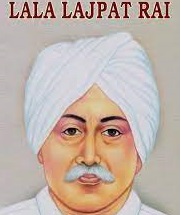
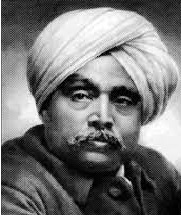
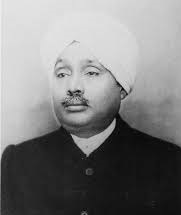
Lala Lajpat Rai
| Born |
28 January 1865 Dhudike, Moga district, Punjab, British India |
| Died |
17 November 1928 (aged 63) Lahore, Punjab, British India |
| Political party |
Indian National Congress |
| Movement | India's independence |
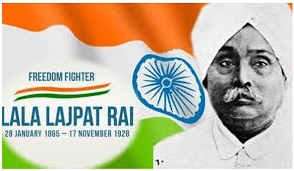
Lala Lajpat Rai (28 January 1865 — 17 November 1928) was an Indian author, freedom fighter, and politician. He played a vital role in the Indian Independence movement. He was popularly known as Punjab Kesari. He was one of the three members of the Lal Bal Pal trimurti. He was also associated with activities of Punjab National Bank and Lakshmi Insurance Company in their early stages in 1894. He died of a heart attack few weeks after sustaining severe injuries during a baton charge by police when he led a peaceful protest march against the all-British Simon Commission Indian constitutional reform.Rai was born on 28 January 1865 Agrawal Jain family as the eldest son of six children of Munshi Radha Krishna, an Urdu and Persian government school teacher and Gulab Devi Aggarwal at Dhudike in Moga district of Punjab Province. He spent much of his youth in Jagraon. His house still stands in Jagraon and houses a library and museum. He also built the first educational institute R.K. High school in JagraonIn the late 1870s, his father was transferred to Rewari, where he had his initial education in Government Higher Secondary School, Rewari, Punjab province, where his father was posted as an Urdu teacher. In 1880, Lajpat Rai joined Government College at Lahore to study law, where he came in contact with patriots and future freedom fighters, such as Lala Hans Raj and Pandit Guru Dutt. While studying at Lahore he was influenced by the Hindu reformist movement of Swami Dayanand Saraswati, became a member of existing Arya Samaj Lahore (founded 1877) and founder-editor of Lahore-based Arya Gazette.In 1928, the United Kingdom set up the Simon Commission, headed by Sir John Simon to report on the political situation in India. The commission was boycotted by Indian political parties because it did not include any Indian members, and it was met with country-wide protests. When the Commission visited Lahore on 30 October 1928, Lajpat Rai led a non-violent march in protest against it and gave the slogan "Simon Go Back!". The protesters chanted the slogan and carried black flags. The police superintendent in Lahore, James A. Scott, ordered the police to lathi charge the protesters and personally assaulted Rai. Despite being severely injured, Rai subsequently addressed the crowd and said "I declare that the blows struck at me today will be the last nails in the coffin of British rule in India".Lajpat Rai travelled to the United States in 1917, and then returned during World War I. He toured Sikh communities along the Western Seaboard, visited the Tuskegee University in Alabama, and met with workers in the Philippines. His travelogue, The United States of America (1916), details these travels and features extensive quotations from leading African American intellectuals, including W.E.B. Du Bois and Fredrick Douglass. While in the United States he had founded the Indian Home Rule League in New York City and a monthly journal, the Young India and Hindustan Information Services Association. Rai petitioned the United States House Committee on Foreign Affairs, painting a vivid picture of maladministration by the British Raj in India, the aspirations of Indian public for independence amongst many other points which strongly sought the support of the international community for the attainment of Indian independence. The 32-page petition, which was prepared overnight, was discussed in the U.S. Senate in October 1917. The book also argues for the notion of "color-caste," suggesting sociological similarities between race in the US and caste in India. During World War I, Lajpat Rai lived in the United States, but he returned to India in 1919 and in the following year led the special session of the Congress Party that launched the non-co-operation movement. He was imprisoned from 1921 to 1923 and elected to the legislative assembly on his release.
A person should be courageous and honest in worshiping the truth, without being concerned about receiving worldly benefits.